
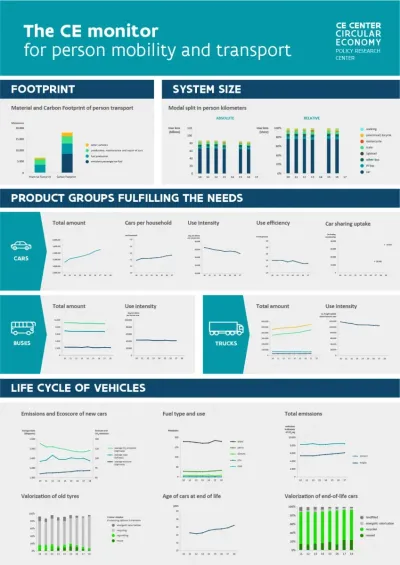
In this report the set of indicators composing the mobility system is presented, as part of the CE monitor developed in the policy research centre. The indicators show that the current state of the mobility system is far from circular, and its evolution seems to continue rather in the linear direction.
Huge amounts of materials are involved with the mobility system, and these amounts have increased over time, with vehicles growing in amounts, and these being used less intensively and efficiently.
There is no substantial evolution in the modal shift towards public transport or bicycles, which take less materials versus persons transported. The popularity of car sharing has strongly increased over the last few years, but it is not possible to conclude anything yet on its impact on car production and use.
New cars entering the market do not become lighter, although their environmental performance is steadily improving. Large amounts of fuels are consumed. Valorization of used tyres is mainly downcycling, with decreasing shares of reuse and reprofiling. Valorization of EoL cars via official demolition has improved a lot: amounts of materials landfilled or incinerated have become minimal, and reuse has increased. Cars tend to be kept in use longer, but it is not clear yet whether the mileage at end of life has increased as well, neither to which extent this balances with environmental impacts.
The compilation of this mobility monitor has been the first elaboration of the concept of systems fulfilling societal needs with indicators. While this concept takes a footprint perspective as a basis, with a lot of attention for consumption, a number of indicators were included in order to reflect the roles of the actors producing goods and services, as was the case for instance for freight transport. The ambition to incorporate micro indicators was only met to a limited extent in the monitor, but the focus on product groups and on the life cycle of products (the so-called ‘meso’ level as denoted before) allows to measure circular economy in a more direct way as progress will be picked up in an early stage.
With respect to data gathering, it appeared that especially cars are relatively easy to track for monitoring, with a lot of data openly available. Still, a number of data did not become accessible within the scope of this work, like use data in car sharing, and total amounts, environmental performance and mileage of EoL cars, and more detailed data on car production. Further action is to be undertaken to gather such data, in order to track progress towards the CE at an even higher level of detail. Indicators on environmental impacts have been limited to greenhouse gas emissions, but in future versions of the monitor also other impact categories will need to be added. Furthermore, indicators focusing on the materials in low-emission vehicles will need to be included.
It was revealed that the data displayed a large diversity and were spread over a large range of sources. Moreover, stakeholder interaction has been essential to obtain the current results. For the future maintenance and development of the CE monitor, it will be important to consider a data governance that enables bringing together and manage data from different stakeholders in a safe and collaborative way.
CE Center co-authors: